British scientists detect signals from the 'zeptoverse', a realm 100 billion times smaller than an atom, after a 42-year hunt
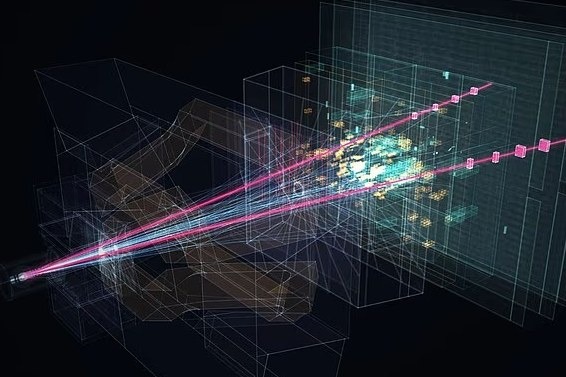
A particle collision event inside the Large Hadron Collider detector at CERN, where Dr Harry Cliff's team used machine learning to isolate genuine decay signals from vast background noise.
Cambridge University's Dr Harry Cliff led the analysis of data from CERN's upgraded LHCb detector, capturing a beauty quark decaying into two muons — an event so rare it occurs just once in every ten billion such particles. The team detected interactions at a scale of a billion-trillionth of a metre, the smallest ever explored by science, after physicists first began hunting for this specific decay back in 1984.
'We're knocking on the door of this zeptoverse,' said Dr Cliff; the team now wants to push deeper to find unknown particles lurking there.
Twenty-eight countries have agreed a £150 million upgrade to the LHCb detector that would increase the decay detection rate tenfold, supplying the extra data needed.
The discovery could unlock the secrets of dark matter, which makes up 85 per cent of the universe but has never been directly observed.