British scientists glimpse the mysterious 'zeptoverse' at Cern after a 40-year hunt for a one-in-10-billion particle decay
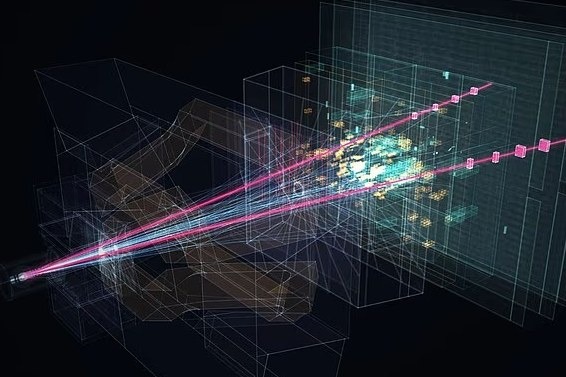
A particle collision event inside the Large Hadron Collider detector at CERN, where Dr Harry Cliff's team used machine learning to isolate genuine decay signals from vast background noise.
Dr Harry Cliff of Cambridge's Cavendish Laboratory led the team that detected an exceptionally rare 'Bd to mu mu' decay — a beauty quark converting into two muons — with the process occurring in just one out of every ten billion such particles. Machine learning proved indispensable for isolating the small number of genuine signals amid the vast amounts of background noise produced by the Large Hadron Collider at CERN. The findings were presented at CERN on 3 November and are still awaiting peer review.
Physicists had pursued this particular decay since 1984, meaning a 42-year search was finally resolved by a single experiment.
The zeptoverse may hold clues to dark matter and the question of why matter outweighs antimatter across the universe.
A £150 million detector upgrade backed by 28 countries would increase decay readings tenfold — yet the UK's research funding agency withdrew its contribution last year.