
Hubble captures a 'cosmic smile' 4.5 billion light-years away as warped spacetime bends galaxy light into a grinning face
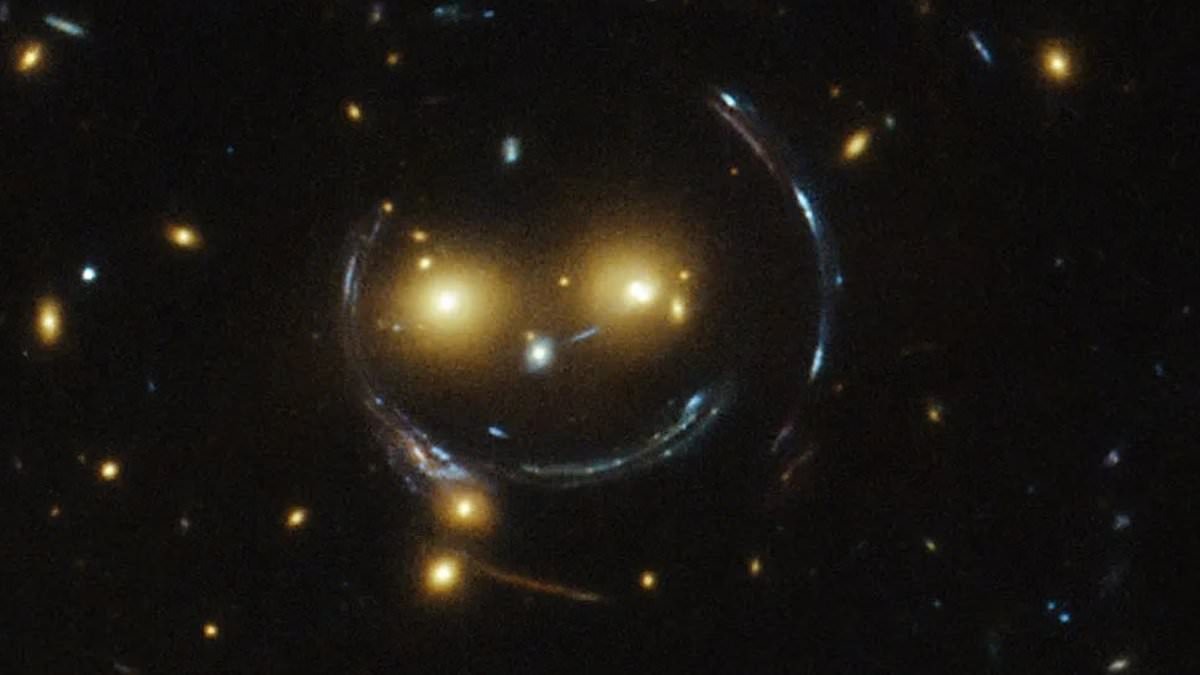
Galaxy cluster SDSS J1038+4849, captured by the Hubble Space Telescope, went viral after NASA released an image bearing a striking resemblance to a cheerful face — two bright orange galaxies serving as eyes, a small white nose, and a wide arc curving into a grin. The cluster lies 4.5 billion light-years from Earth in the constellation Ursa Major. NASA confirmed the effect is not coincidence but a precise optical phenomenon known as strong gravitational lensing, in which the cluster's immense mass distorts spacetime and redirects light from galaxies far behind it into sweeping arcs.
The two 'eyes' are real galaxies — SDSSCGB 8842.3 and SDSSCGB 8842.4 — while the smile is distorted light from entirely different, more distant galaxies behind the cluster.
The curved arcs form what scientists call an Einstein ring, a rare perfect alignment first predicted by Albert Einstein where bent light closes into a full circle around the lensing mass.