
Researchers reconstruct face of battle-scarred 'Conquest Man' who was neither Norman nor Saxon but probably Scandinavian

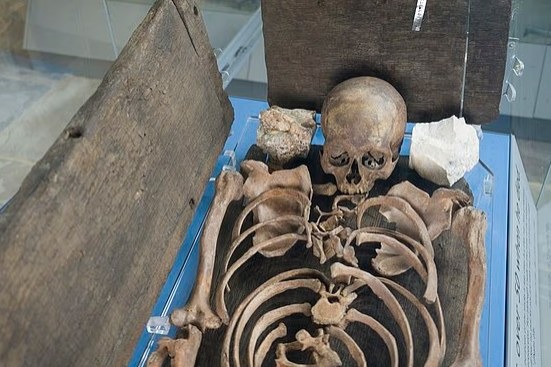
Dubbed Conquest Man, the skeleton was unearthed at St Peter's Church in Barton-upon-Humber, Lincolnshire — the private church of one of William the Conqueror's knights — and DNA, isotope and skull-shape analysis now points firmly to Scandinavian origins.
His oak coffin was made from a tree felled around 1079, meaning he was born under Viking King Cnut and died in his 50s or 60s after surviving the Conquest.
Three apple-wood staffs — sacred in Scandinavian tradition — were placed in the grave alongside him, while his head lay on a grass pillow supported by a pair of chalk fragments sourced locally.
Kevin Booth, English Heritage's head curator of collections, says: 'He's a fascinating survivor of a cataclysmic period in history — it feels like we can almost speak to him.'